
Journal Insights
Comparison of the outcomes of enhanced recovery after surgery and traditional recovery pathway in robotic hysterectomy for benign indications: a randomized controlled trial
Contents
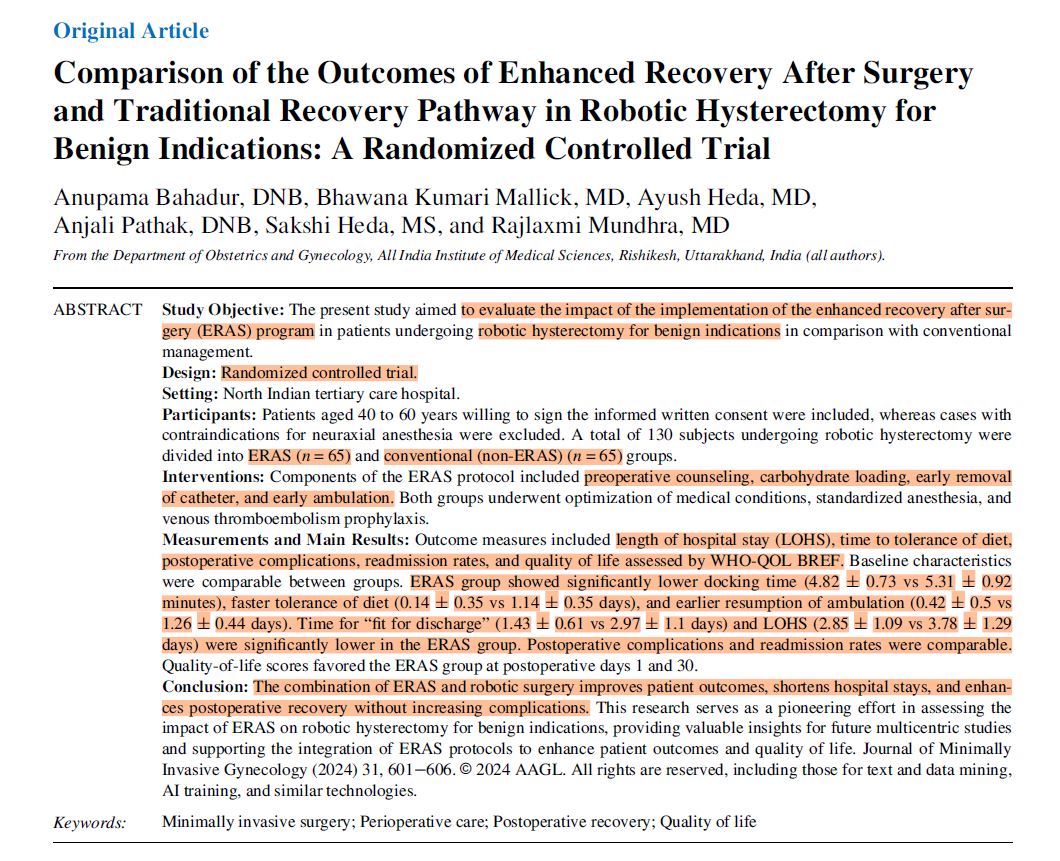
The study aimed to evaluate the impact of implementing the Enhanced Recovery After Surgery (ERAS) program in patients undergoing robotic hysterectomy for benign conditions compared to conventional management. Conducted at a tertiary care hospital in North India, this randomized controlled trial included 130 patients aged 40 to 60, divided into ERAS and conventional groups. Key ERAS components involved preoperative counseling, carbohydrate loading, early catheter removal, and early ambulation. The study found that the ERAS group experienced significantly shorter docking time, faster diet tolerance, earlier ambulation, and shorter hospital stays without increased complications or readmission rates. Quality of life was notably better in the ERAS group at both postoperative days 1 and 30. The research concludes that combining ERAS with robotic surgery enhances patient outcomes and supports the integration of ERAS protocols in such procedures to improve recovery and quality of life.
Citation
Bahadur A, Mallick BK, Heda A, Pathak A, Heda S, Mundhra R. Comparison of the Outcomes of Enhanced Recovery After Surgery and Traditional Recovery Pathway in Robotic Hysterectomy for Benign Indications: A Randomized Controlled Trial. J Minim Invasive Gynecol. 2024 Jul;31(7):601-606.
Link
https://www.sciencedirect.com/science/article/pii/S1553465024001985?via%3Dihub
💬 Comments 0
No comments
You can write comments after you log in.